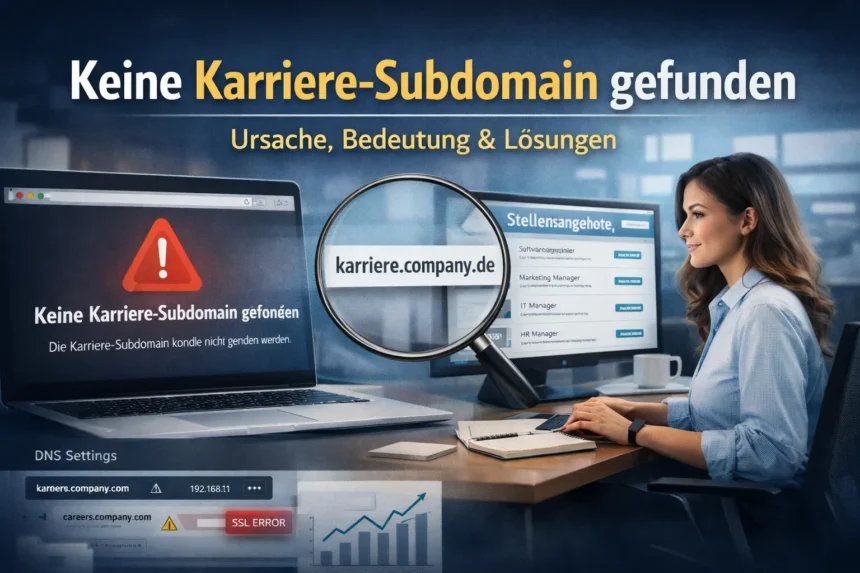
The phrase “keine karriere-subdomain gefunden” is German and translates directly to “no career subdomain found.”
In plain English, it means that a system, tool, or automated check could not detect a dedicated careers subdomain such as:
karriere.company.comcareers.company.comjobs.company.com
Instead of indicating an error with your business or website security, this message simply highlights that no separate careers subdomain exists or is reachable.
This message most commonly appears in environments related to:
- Career pages
- Job portals
- Applicant tracking systems (ATS)
- HR and recruiting tools
- Website or SEO audits
Why does this message appear?
This keine karriere-subdomain gefunden message usually appears when a scanner, HR platform, or automated tool expects a dedicated career subdomain but cannot find one.
Common triggers include:
- An ATS checking where job listings should live
- An HR tool validating company career infrastructure
- An SEO or site audit assuming a careers subdomain exists
It is important to understand that this is not a security warning.
It is a structural or configuration notice that reflects how your careers section is organized.
Career Pages and Subdomains
What is a career subdomain?
A career subdomain is a separate subdomain used exclusively for job listings and employer information.
Examples include:
careers.company.comjobs.company.comkarriere.company.de
This differs from a subfolder, which would look like:
company.com/careerscompany.com/karriere
Subdomains are often used when:
- Careers are hosted on a separate platform
- A third party ATS manages job listings
- The careers site has different infrastructure or design needs
Where do companies usually place their careers section?
Most companies follow one of these patterns:
Subdomain
careers.company.comkarriere.company.de
Subfolder
company.com/careerscompany.com/karriere
Separate domain
company-jobs.comcompanycareers.com
From an SEO perspective:
- Subfolders help consolidate domain authority and are often simpler
- Subdomains make sense for large organizations or complex ATS setups
There is no single correct choice. The best option depends on company size, hiring volume, and technical needs.
Main Causes of “keine karriere-subdomain gefunden”
Technical causes
One of the most common reasons is that no career subdomain was ever created.
Typical technical issues include:
- No DNS record for
careers.company.comorkarriere.company.de - Incorrect DNS configuration such as broken A, AAAA, or CNAME records
- DNS pointing to an inactive or removed server
Another frequent issue is SSL misconfiguration.
If the career subdomain exists but lacks a valid SSL certificate, modern tools and browsers may treat it as inaccessible.
Website and information architecture causes
Many companies host their careers section as a subfolder, not a subdomain.
For example:
- Careers exist at
company.com/careers - The tool only checks for
careers.company.com
In this case, the careers page works perfectly for users, but automated tools fail to detect it.
Other structural issues include:
- Careers content split between the main site and an external ATS
- Outdated links pointing to a career subdomain that no longer exists
- Renamed or removed subdomains not properly redirected
Tool or configuration issues
Some HR, ATS, or SEO tools are hardcoded to expect a specific pattern, such as careers.company.com.
If your company uses:
- A subfolder instead of a subdomain
- A different naming convention
- An external ATS domain
The tool may still flag the message even though nothing is broken.
In these cases, the issue lies with tool configuration, not your website
Read Also: 010100nbc: Meaning, Use Cases and Technology Context
Why This Matters (SEO, UX, HR)
Impact on applicant experience and conversions
If a career subdomain is missing or broken:
- Applicants may encounter 404 pages
- Users may be redirected unexpectedly
- Trust and credibility can suffer
A confusing or inconsistent career experience can directly reduce:
- Job applications
- Completed application rates
- Employer brand confidence
Impact on SEO and visibility
Career pages often target valuable keywords such as job titles, locations, and employer brand terms.
Poor configuration can cause:
- Career pages not being crawled or indexed
- Job listings missing from search results
- Diluted authority across domains or subdomains
Without clear internal linking and structure, search engines struggle to understand where career content belongs.
Impact on analytics and tracking
When careers live on a separate subdomain:
- Analytics tracking must be configured correctly
- Cross domain tracking is required
- Conversion events can break easily
Misconfigured subdomains often result in:
- Incomplete recruitment funnel data
- Lost attribution for job applications
- Inaccurate reporting for HR teams
How to Fix “keine karriere-subdomain gefunden”
Step 1: Check your current structure
Start by identifying where your career content lives:
- Subdomain
- Subfolder
- External ATS domain
Then confirm whether any tools explicitly expect a subdomain.
Step 2: Decide on the ideal setup
Choose the structure that fits your organization:
- Dedicated subdomain for large or global companies with complex hiring needs
- Subfolder for small to medium companies prioritizing SEO and simplicity
Once decided, align all tools and teams around this structure.
Step 3: Configure DNS and hosting
If using a career subdomain:
- Create proper DNS records
- Point them to the correct server or ATS
- Ensure SSL certificates are valid and active
- Enforce HTTPS with proper redirects
Step 4: Implement redirects and navigation
If old career URLs exist:
- Use 301 redirects to guide users and search engines
- Avoid leaving broken career links live
Add clear navigation:
- Header and footer links
- Contextual links from about and company pages
Step 5: Optimize for SEO and UX
A strong careers section should include:
- A clear careers landing page
- Employer brand messaging
- Benefits and culture information
- Job listings with structured data
- FAQs about hiring and applications
Ensure:
- Fast load times
- Mobile friendly layouts
- Clean and descriptive URLs
Step 6: Re test and monitor
After fixes:
- Re run the tool that showed the message
- Confirm detection or proper configuration
- Monitor crawl data and indexing
- Track job traffic and application conversions
Read Also: Importance of Teckaya Construction Equipment Ltd
Best Practices for Career Subdomains
When to use a subdomain vs subfolder
Use a subdomain when:
- Careers require separate infrastructure
- ATS hosting demands isolation
- Hiring volume is high and complex
Use a subfolder when:
- SEO consolidation is a priority
- Technical simplicity is preferred
- Hiring needs are moderate
Technical and content hygiene
Best practices include:
- Consistent branding across main site and careers
- Regular cleanup of expired job listings
- Avoiding dead links and outdated postings
- Clear internal linking between site sections
HR, ATS, and integration tips
Always coordinate changes between:
- Marketing
- IT
- HR teams
Ensure:
- Job board links remain stable
- ATS integrations are updated
- URL structures remain consistent over time
Does a career subdomain improve SEO automatically?
No.
SEO benefits depend on:
- Content quality
- Technical health
- Internal linking
- User experience
A poorly implemented subdomain can perform worse than a well structured subfolder.
Conclusion: keine karriere-subdomain gefunden
“Keine karriere-subdomain gefunden” is not an error to panic about.
It is a signal to review how your careers section is structured, detected, and accessed.
By understanding the cause and aligning your technical setup, HR tools, and SEO strategy, you can ensure a smooth hiring experience for both applicants and internal teams.
If done correctly, your careers area becomes a strong extension of your brand rather than a hidden or fragmented section of your website.