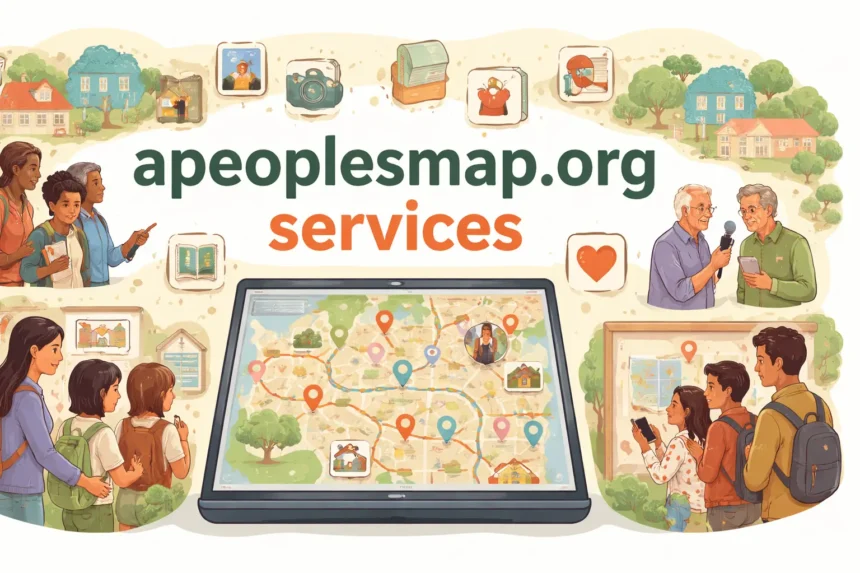
Apeoplesmap.org services provide a people-centered alternative to traditional mapping platforms by combining interactive maps with community stories, local histories, and ethical data practices. Instead of focusing only on roads, buildings, or commercial locations, these services highlight lived experiences, cultural memory, and social realities tied to place.
At a time when many maps feel abstract and top-down, apeoplesmap.org offers tools that allow communities to document their own spaces, preserve local knowledge, and share stories on their own terms.
Introduction to apeoplesmap.org Services
Apeoplesmap.org is a community-driven digital mapping platform designed to document people’s stories, histories, and relationships to place.
These services matter today because many local histories, cultural memories, and lived experiences are missing from mainstream maps. apeoplesmap.org fills this gap by supporting transparent, community-owned knowledge rooted in real places and real people.
In one line: apeoplesmap.org services offer interactive maps, storytelling tools, and ethical data systems that center community voices rather than institutional perspectives.
Key Features of apeoplesmap.org Services
Interactive Community Maps
The platform offers zoomable, clickable maps where users can explore locations connected to stories, photos, and historical context.
Maps often include multiple layers showing:
- Past and present neighborhood conditions
- Changes in land use over time
- Cultural, social, and environmental markers
The interface is intentionally simple, making it accessible for non-technical users, younger audiences, and classroom environments.
Community Stories and Narratives
One of the most powerful apeoplesmap.org services is the ability to attach stories directly to places.
Contributions may include:
- Personal memories
- Oral histories and interviews
- Community narratives passed down through generations
By including elders’ voices and lived experiences, the platform helps preserve fragile knowledge that is rarely captured in official records.
Photos, Media, and Visual Archives
Visual media plays a key role in helping users recognize, remember, and re-imagine places.
Maps can include:
- Historical and contemporary photographs
- Scanned documents or visual artifacts
- Media from community archives
These visuals help connect abstract locations to real human experience and collective memory.
Community-Led Mapping and Land Use Documentation
apeoplesmap.org services support community-led documentation of land, housing, public spaces, and environmental resources.
Common use cases include:
- Mapping development pressure and displacement
- Documenting public space access
- Recording environmental risks and community assets
Importantly, communities retain control over sensitive data and how it is shared.
Data Control, Privacy, and Ethical Knowledge Sharing
Ethical data practices are central to the platform.
Key protections include:
- Contributor consent and boundaries
- Options for anonymity or limited visibility
- Avoidance of extractive data use
The goal is to share knowledge without exposing communities to harm or exploitation.
Read Also: 8124708134 – Who Called Me From This Number?
Types of apeoplesmap.org Services
Free Public Mapping Tools
Public users can freely browse maps, read stories, and explore neighborhoods.
Maps may be navigated by:
- Location
- Theme
- Timeline or historical period
This open access supports transparency and public learning.
Contribution and Participation Services
Residents and community members can submit stories, photos, and mapped locations.
Submissions typically follow:
- Clear contribution guidelines
- Review and moderation processes
- Community standards for respect and accuracy
This ensures quality while remaining inclusive.
Educational and Classroom Uses
apeoplesmap.org services are well-suited for teaching local history, civics, and geography.
Example classroom activities include:
- Mapping family or migration histories
- Documenting neighborhood landmarks
- Exploring how space relates to power and inequality
Students benefit from active, place-based learning rather than passive memorization.
Support for Community Organizers and Planners
Community groups can use the platform to visualize:
- Housing conditions
- Environmental risks
- Cultural and social assets
These visualizations support advocacy, participatory planning, and public engagement efforts.
Research, Evaluation, and Policy Uses
Researchers and policymakers can use mapped stories as qualitative and spatial data.
These insights help:
- Complement statistical datasets
- Reveal marginalized perspectives
- Inform community-responsive policy decisions
How apeoplesmap.org Services Work
Accessing the Platform
Users begin by visiting the website and selecting a map or region of interest.
The platform typically works across:
- Desktop devices
- Mobile browsers
The interface emphasizes clarity and ease of navigation.
Navigating Maps and Layers
Users can:
- Zoom and pan across areas
- Search for places or themes
- Toggle layers representing different story types
Pins and icons visually distinguish categories such as history, culture, or land use.
Adding Stories and Places
Contributing usually involves:
- Selecting a location
- Writing a description or a story
- Uploading photos or media
- Choosing categories or tags
Submissions are reviewed before publication to maintain safety and relevance.
Managing and Protecting Data
apeoplesmap.org emphasizes responsible data storage.
Safeguards may include:
- Anonymity options
- Pseudonyms
- Community governance or advisory oversight
This approach balances openness with protection.
Benefits of apeoplesmap.org Services
For Local Communities
- Preservation of local history and cultural memory
- Stronger sense of belonging and pride
- Support for mutual aid and collective action
For Educators and Students
- Ready-to-use, place-based learning materials
- Student-led research and storytelling opportunities
- Deeper engagement with local realities
For Researchers and Planners
- Rich qualitative spatial data
- Community-informed perspectives
- Improved equity in planning and policy discussions
Read Also: 18552311590 – Who Called Me From This Number?
Real-World Examples and Use Cases
Community Storytelling Projects
Regional people’s maps often document overlooked histories, such as migration, labor, or cultural traditions. These projects inform planning and cultural programming.
Community Land Mapping and Anti-Displacement Work
Maps can document housing struggles, land claims, and environmental injustice, providing evidence for advocacy and policy change.
Partnerships with Archives, Museums, and Libraries
Collaborations with cultural institutions allow digital maps to connect with physical exhibits, public events, and curated collections.
Comparing apeoplesmap.org Services with Traditional Mapping Tools
| Aspect | apeoplesmap.org services | Traditional web maps |
|---|---|---|
| Primary focus | Community stories and lived experience | Navigation and commercial data |
| Data ownership | Community-centered and ethical | Corporate or institutional |
| Content type | Narratives, photos, oral histories | Addresses and routes |
| Participation | Open community contributions | Limited user input |
| Core goal | Preserve memory and support justice | Optimize travel and search |
Getting Started with apeoplesmap.org Services
Steps for New Users
Users can often explore without creating an account. A good starting point is familiar neighborhoods before expanding outward.
Best Practices for Contributors
- Write respectful, accurate stories
- Choose photos that add context
- Protect privacy and consent
Collaborating with elders and neighbors strengthens contributions.
How Organizations Can Engage
Schools, nonprofits, and community groups can partner to:
- Run mapping workshops
- Support participatory planning
- Host public storytelling events
FAQs About apeoplesmap.org Services
Is apeoplesmap.org free to use?
Yes, public exploration is typically open and free.
Who can submit stories or locations?
Residents, community members, and partner organizations, subject to guidelines.
How are submissions moderated?
Content is reviewed to ensure safety, relevance, and respect.
Can stories be removed later?
Yes, contributors can request edits or removal.
How is sensitive information protected?
Through consent practices, privacy controls, and ethical governance.
Can data be exported for research?
Some projects allow controlled data sharing depending on community agreements.
Are there region-specific projects?
Yes, many maps focus on specific cities or pilot areas.
Conclusion: Why apeoplesmap.org Services Matter
apeoplesmap.org services redefine what mapping can be. By centering people, memory, and ethics, the platform transforms maps into tools for preservation, justice, and community empowerment.
For anyone interested in local history, education, research, or community action, exploring and contributing to apeoplesmap.org offers a meaningful way to make place-based knowledge visible and lasting.