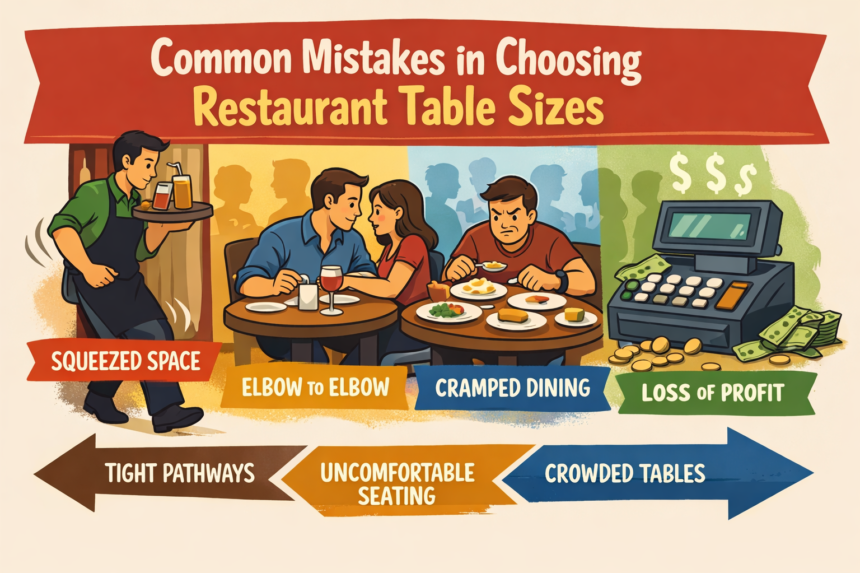
It seems easy to choose the right size for a restaurant table, but when the room is full, servers have to squeeze past seats, guests are elbow to elbow, and the eating area feels awkward. That’s when owners see that the size of the table isn’t only a matter of furnishings. It’s a judgment about comfort, traffic movement, and in many cases, profit.
A table can look great in a store, but when you put it on a real floor with actual people, plates, and movement, it can be entirely wrong. A lot of people look at the shape, finish, or price first. People forget to think about how the table works when chairs are pushed out, food is delivered, and the service gets busy. In real life, even a tiny miscalculation in size can change how quickly things move, how well personnel work, and how relaxed consumers feel. The restaurant business is still huge. Eating and drinking locations made up around 72 percent of all restaurant and foodservice revenues in the most recent National Restaurant Association report. This is one reason why layout selections are so important at the operational level.
Understanding restaurant table sizes becomes critical at this stage, because standard dimensions exist for a reason. A two-person table is often around 24 by 24 inches, while a four-person setup usually ranges from 30 by 30 to 36 by 36 inches, and larger groups may require 72-inch tables or combined layouts. These measurements are not random. They are designed to balance personal space, plate placement, and server access, all while keeping the dining room efficient and comfortable.
The good news is that most mistakes in table size are easy to see coming. The same things happen to them over and over. Instead of measuring, they guess. They prepare rooms that aren’t being used instead of rooms that are. They buy things to look good, not to use them. Once you know where those mistakes frequently happen, it’s much easier to avoid making costly choices.
Thinking About Seats Instead of Space
One of the most typical blunders is asking, “How many people can sit here?” instead of “How much space does each person need to sit here comfortably?” while choosing a table. Those two questions are not the same.
A four-top can hold four people, but that doesn’t imply it should. The size of the plates, the type of glassware, the way the food is served, and how long people remain all affect how comfortable they feel. Sometimes, a casual lunch place can operate better with smaller tables than a full-service restaurant where people order beverages, appetizers, entrees, and desserts all at once. Standard restaurant size standards usually say that a two-top should be roughly 30 by 30 inches or about 30 to 36 inches round. This illustrates that even the industry thinks of comfort as a spectrum, not a single magic figure.
This is where simple math tricks people. They think the task is done when they see four chairs around a table. But when you add elbows, bags, shared plates, sauces, and movement, the table starts to feel smaller than it did on paper. People don’t usually say this is “wrong table sizing.” They just mention that the space feels small.
Ignoring the Reality of Pulled-Out Chairs
A table does not exist by itself. It exists with chairs around it, and the chairs move.
That sounds obvious, but it gets ignored all the time. Many people measure only the tabletop footprint and forget that the real dining footprint expands the moment someone sits down. A table may fit nicely in a floor plan drawing, but once every chair is occupied and pushed back, walkways shrink fast. Restaurant design references often recommend planning around access and service aisles, with common guidance placing service aisles at around 36 inches to better support staff and accessibility needs.
This mistake usually appears in smaller restaurants, cafes, and remodels where every square foot feels precious. Owners try to squeeze in one more table, thinking it will improve revenue. Sometimes it does the opposite. A crowded room can slow service, increase bumps and spills, and make customers less likely to settle in comfortably.
When table sizing is handled well, the room feels effortless. When it is handled badly, people notice the friction even if they cannot explain it.
Choosing Oversized Tables for Visual Impact
Big tables can look nice. They provide a room with a polished, high-end look and feel. But apparent weight isn’t the same as actual value.
People sometimes make the mistake of choosing tables that are too broad or too long because they look fancy in staged images. When used, the tables can leave space between visitors, make it harder to share meals, reduce the number of seats, and complicate traffic patterns. A bigger table doesn’t merely take up more space in some layouts. It throws off the balance of the whole floor.
This is especially true for eateries that want to change things up. If a room is often used by couples, small families, and sometimes groups, very large permanent tables can get in the way. It’s usually better to pick sizes that can be put together or moved around without making the room feel broken when the traffic changes.
People often recall how a table looked spectacularly, but they forget how it fit into their daily lives. Restaurants don’t work like picture shoots with models. They work by repeating, moving, and putting pressure on things.
Forgetting That Table Height Matters Too
When people talk about the size of restaurant tables, they usually mean how wide, how long, or how big they are. People don’t pay much attention to height, even though it has a big impact on comfort. Most dining tables are about 28 to 30 inches high, which is the standard height for dining. ADA-compliant dining surfaces, on the other hand, must be between 28 and 34 inches high. (Durian)
A table that is too high or too low makes you modify your posture right away. Guests can feel it in their shoulders and wrists, and in their overall comfort. It might not destroy the meal, but it can make it less fun without you knowing it. That matters because comfort remains one of the factors customers say affects their dining experience. The 2025 industry report from the National Restaurant Association lists comfortable tables and chairs as among the things diners notice.
When you sit in an improper chair, height difficulties are significantly worse. It can feel strange to sit at a good table if the seat height doesn’t match it. That’s why you should never choose the size of a table by itself. It should always be considered part of the overall seating system.
Treating Every Part of the Dining Room the Same
Another mistake is assuming that a single table size should be used everywhere. It feels clean, simple, and easy to order, but real restaurants rarely work best that way.
The front window area may suit smaller two-tops. A family-friendly section may need more four-tops. A flexible center zone may benefit from tables that can be pushed together. Banquette seating changes the equation again because booth layouts can often accommodate different spacing choices than free-standing chairs. The point is not to create visual chaos. The point is to let each part of the room serve its own purpose.
A smarter layout usually comes from intentionally mixing sizes. That makes the restaurant feel more natural because it reflects how people actually dine. Not every guest arrives in the same group size, stays the same length of time, or uses the table in the same way.
- Small two-top tables help with couples and faster table turns
- Standard four tops usually form the backbone of a flexible dining room
- Larger tables work best when there is a clear reason for them, not just because they look impressive
Overlooking Accessibility From the Start
People frequently think of accessibility as a last step instead of an early design objective. That’s a problem because making tables accessible affects both compliance and their everyday usability.
There are a few basic points the ADA guidelines for dining surfaces make clear. Dining surfaces must be between 28 and 34 inches high, with enough space underneath for knees and toes. This means there must be at least 27 inches of knee clearance height and a clear width typical of an accessible seating area.
People are surprised that a table might look easy to access, yet the foundation design makes it hard to use or even awkward to use. Some pedestal bases or support structures can obstruct knee clearance, even if the tabletop height looks fine. That’s why the size of a table isn’t just about the top. The area underneath is just as important.
Making accessibility plans early on often results in better layouts overall. It makes the circulation cleaner, the spacing more intentional, and the space more welcoming for all customers, not just those who need accessible seats.
Letting Shape Decide Everything
Round, square, and rectangular tables each have strengths. Problems begin when people prioritize shape over function.
Round tables often feel social and soft. They can work beautifully in certain dining rooms, but they are not always the most efficient use of floor space. Square tables are tidy and easy to align, though they can become awkward in tight traffic paths. Rectangular tables are versatile, but if chosen too large for the room, they can make spacing problems much worse.
There is no universal winner. The mistake is assuming a shape is right because it looks stylish or because another restaurant used it well. The right table shape depends on traffic, party sizes, service style, and whether flexibility matters more than symmetry.
In other words, shape should support the room, not control it.
Guessing Instead of Mocking Up the Floor
Many sizing mistakes happen because people never test the room in a realistic way before buying. They measure once, draw a rough plan, and trust it.
That approach misses too much. A much better method is to tape out table footprints on the floor, add chair positions, and physically walk the aisles. Suddenly, problems become obvious. Corners feel tighter. Sightlines change. Server paths become clearer. What looked efficient on paper may feel stressful in motion.
This kind of mockup work is not glamorous, but it saves money. It is far easier to correct a tape outline than to replace a shipment of tables that looked right only in theory.
- Measure the table footprint.t
- Add the pulled-out chair footprint
- Walk the path as a guest and as a server
- Check whether the room still feels calm, not just technically functional
Buying for the Opening, Not for the Long Term
Some operators pick table sizes based entirely on how excited people are on launch day. They see a full house, a well-organized space, and a full reservation book. That can lead you to make choices that seem big but are hard to deal with afterward.
A restaurant learns what its genuine traffic is like over time. It might get more couples than groups. Maybe getting food to go makes the dining room less busy. The quieter part with a little more space to breathe might be the most popular. A layout that doesn’t allow for any changes will quickly become annoying.
The best table layout usually has some flexibility for change. Not vacant space for no reason, but enough area to move things around, combine tables, or adjust the way people use the room.
Where Better Decisions Usually Begin
Most of the time, people make mistakes when sizing restaurant tables because they think that a table is merely a surface. No, it isn’t. It has to do with circulation, comfort, sound, accessibility, service speed, and even how the environment makes you feel.
People make the best decisions about size when they stop asking how many tables can fit and start questioning how the room should work when it is full. When that becomes the aim, the options get better. When you use them, tables stop being abstract pieces of furniture and become tools that enhance the dining experience.
That’s why the best restaurant settings don’t usually feel like they were made by chance. Someone looked beyond the catalog images and thought carefully about bodies, mobility, service, and comfort when choosing the proportions of their tables. Guests might never exclaim, “These table sizes are perfect.” Still, they feel the result is practically right once, and that sense is what keeps a dining room going.