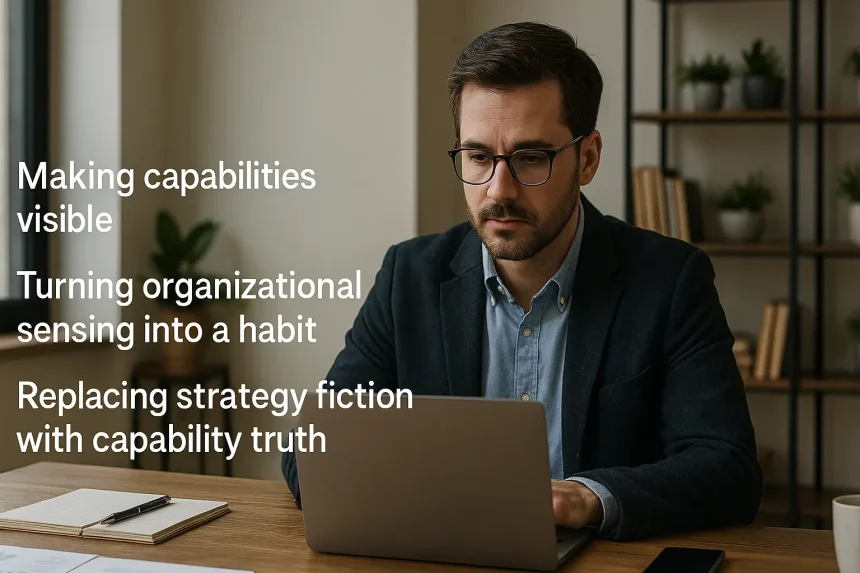
The question at the heart of this journey is simple yet uncomfortable: why Im building CapabiliSense Medium instead of quietly building the product behind closed doors. The truth is that modern organizations struggle with one fundamental gap: they simply cannot see their own capabilities clearly. Strategies are created faster than teams can absorb them, and leaders often rely on narratives, slide decks, and optimistic assumptions rather than grounded capability data.
CapabiliSense is an attempt to fix this, and writing publicly about it—via a Medium-style narrative—is not a distraction but a critical part of the methodology.
The Problem: Scattered Information and Capability Blindness
Most companies operate in capability fog.
Skills data is scattered across:
- CVs
- HRIS records
- Learning platforms
- Strategy decks
- Job descriptions
- Random spreadsheets
With no unified visibility, leaders make transformation bets, AI adoption decisions, and hiring choices without understanding what their people can actually execute. The result is predictable:
- Transformation programs stall
- Roles are mismatched
- Strategies sound compelling, but fail in execution
- Teams operate on heroic effort instead of structural clarity
Organizations don’t lack ambition—they lack capability intelligence.
Personal Journey: How I Came to Build CapabiliSense
This story began during years spent in strategy, transformation, and product roles. The pattern was always the same:
- Beautiful plans created in PowerPoint
- GTM strategies that looked perfect in theory
- Leadership narratives filled with optimism
- And zero grounding in real capabilities on the ground
Inside war rooms and transformation meetings, the gap was glaring: the strategy and the people were living in different realities.
The most honest moments came from field teams expressing constraints that never appeared in executive slides. This dissonance, the distance between strategy fiction and capability truth, sparked the realization that capability sensing was missing. The idea grew into early prototypes, thought experiments, and finally the architecture of CapabiliSense.
What CapabiliSense Is: A Capability Intelligence Platform
CapabiliSense is designed as a capability intelligence engine—a system that helps leaders understand:
- What the organization can actually execute
- Where the capability gaps are
- Which plans are feasible given existing skills
- Which initiatives require hiring vs upskilling
- What a realistic, capability-aware action plan looks like
Unlike traditional HR dashboards or skills-inventory tools, CapabiliSense goes further:
It connects capabilities to strategy and operational constraints such as time, budgets, team structures, and headcount. That makes it not just a skills platform but a sensing, alignment, and action engine.
Why CapabiliSense Medium Matters in the Build Process
The decision to build CapabiliSense Medium is intentional. Writing publicly is part of the capability-sensing loop.
Publishing articles serves three purposes:
- Real-world testing: Each piece tests a concept with real readers, not hypothetical personas.
- Reflection and iteration: Writing forces clarity and validates which ideas resonate.
- Founder-as-product: The same diagnostic methods used in organizations are applied to the founder—mapping capabilities, identifying gaps, and creating action plans through public writing.
This is why Im building CapabiliSense Medium matters: the writing is a research lab, a feedback machine, and a real-time probe into market pain points.
Core Principles Behind CapabiliSense
CapabiliSense is built on a set of non-negotiable principles:
Capability Before Strategy
A strategy without capability alignment is just a slide deck.
Evidence Over Rhetoric
Documents, plans, and org data provide truth; narratives often distort it.
The Sensing → Aligning → Acting Loop
- Sense existing capabilities
- Align them with priorities
- Act with realistic plans
And repeat continuously.
Read Also: Edio Login: Complete Guide to CCA’s Online Learning Portal
How CapabiliSense Works at a High Level
Without revealing proprietary mechanics, the conceptual workflow is simple:
Input Layer
- Strategy documents
- Job descriptions
- Org charts
- Project portfolios
- Learning data
- Headcount and budget information
Analysis Layer
AI-driven semantic models identify:
- Existing capabilities
- Gaps and risks
- Latent strengths
- Misalignments
- Actionability constraints
Output Layer
Produces capability-aware insights and action plans such as:
- Which teams can execute which initiatives
- Which skills are missing and require hiring
- What realistic timelines look like
- Where capability bottlenecks will occur
The system is designed to be human-interpretable, not a black-box generator.
The Pivot and Current Status: Mission Paused, Not Dead
As described in the founder’s recent reflections, CapabiliSense, as a startup, is currently paused. The reason is straightforward:
Without pilot customers, every GTM plan would be fiction—and fiction is the exact problem CapabiliSense aims to eliminate.
Instead of building in a vacuum, the founder chose to return to a senior role inside an organization to reconnect with real, lived corporate pain points. During this period, the methodology is being applied to the founder’s own search:
- Capability mapping
- Crux analysis
- Strategic fit assessments
- Company deep dives
This pause is not an ending. It’s a recalibration that ensures the next version of CapabiliSense is shaped by authentic, validated needs.
How CapabiliSense Medium Will Be Structured
Readers can expect three forms of content:
Case-Style Breakdowns
Examples showing how capability mapping clarifies strategy, hiring, and transformation decisions.
Deep-Dive Essays
Topics like:
- Skills mapping
- Capability frameworks
- Crux analysis
- Organizational sensing
Open Reflections
What is working, what is not, and how the methodology evolves through real-world use.
This makes CapabiliSense Medium a living laboratory of ideas.
Read Also: QLink Login: Complete Guide to Q Link Wireless and Other QLink Portals
Where CapabiliSense Fits in the Skills Intelligence Landscape
The market includes platforms like:
- Skills Base
- Workera
- TalentGuard
- 365Talents
- Codility
These platforms focus on skills inventories, assessments, and learning recommendations.
CapabiliSense is complementary because:
- It begins with existing documents and org structures, not assessments.
- It connects skills to actual strategic execution.
- It generates capability-aware action plans, not just dashboards.
Medium writing helps sharpen this differentiation in a public and transparent manner.
Best Practices: How Leaders Can Apply CapabiliSense Before the Product Is Built
Leaders can start using CapabiliSense principles today:
1. Collect Existing Documents
Gather plans, org charts, role descriptions, and project data in one place.
2. Ask Capability Questions
- Can we actually execute this?
- Do we have the required skills?
- What are the timeline constraints?
3. Prototype a Capability Map
Even a small manual analysis of one team can reveal misalignments.
These simple steps replicate the early manual version of what CapabiliSense aims to automate at scale.
FAQ: Why Im building CapabiliSense Medium
What problem is CapabiliSense trying to solve?
Organizations lack clarity on what their people can truly accomplish. CapabiliSense makes capabilities visible, measurable, and actionable.
How is CapabiliSense different from other skills intelligence tools?
Others focus on dashboards, learning paths, or skill assessment. CapabiliSense connects capabilities directly with strategy, budgets, and realistic action plans.
Why write on Medium instead of building in silence?
Public writing validates ideas, tests demand, and aligns the product with real-world experiences.
If CapabiliSense is paused, why keep writing about it?
Writing is part of the research loop. It helps refine the methodology and prepares the ground for a targeted future iteration.
Who should follow CapabiliSense Medium?
Leaders in strategy, HR, talent, transformation, and operations who want a practical approach to connecting skills with strategy.
Conclusion: Why Im building CapabiliSense Medium
Why Im building CapabiliSense Medium is not a branding exercise; it is a commitment to building a movement around capability-aware strategy. The product is paused, but the mission is alive:
- Making capabilities visible
- Turning organizational sensing into a habit
- Replacing strategy fiction with capability truth
Through writing, consulting, and continuous learning, CapabiliSense continues evolving—sharper, clearer, and more grounded than before.